Hi Person Studios

Final Major Project
This page was designed before I changed aesthetics
Research
My main ideas for creating a music video:
-
Alien Blues – Vundabar
-
The video will be a mesh of concept and performance. The video will follow a character who is struggling with life and has a lot of bad things a lot of people deal with for example debt or depression. The performance side of it will transition to slow motions of the person in a manic state and slow motions of items breaking to connote symbolism of breaking down and not being able to help themselves.
-
-
Car Radio – Twenty-One Pilots
-
It will go from location to location with the actor in the same position. It will have slow motions of the person’s feet walking between each location e.g., it will cut from one to another with each step to the beat. This will be at the instrumentals. During the end of the song, it picks up a rockier tone and I will cut to beat between a calm person and an anxious/angry person. The end of the video will be when the music has stopped, and they look around after taking a deep breath and walking away so a cyclical structure to connote life is a constant.
-
-
Liquid Smooth – Mitski (the song I have chosen)
-
It will start with an artsy slow motion of the person singing and flashing between slow motions of flowers falling and when the chorus comes in the flowers will start to be more distorted such as burning or rotten. The idea of getting more distorted will continue throughout the video and get more noticeable. There will be shots of the actor underwater and lip-syncing. As the bass starts to have a heavier impact on the song more disturbing aspects will happen for example an image of their sin being torn off, falling and rain ruining their makeup. As the song continues the variety will increase with videos being reversed and effects being added to create a sense of mania.
-
Analysis
These analysis' helped me decide what my final music video would be.
Sarah Fils
https://www.youtube.com/@sarahfils
Sarah Fils is a small media creator who creates disturbing body morph videos that focus on distorting reality. They focus on this by manipulating the eyes to show the disturbing reality of realism. The 17-year-old started their YouTube channel to post their original music in 2021 and now they focus on making dystopia short films and expanding their career through their YouTube and TikTok. The reason I mention them is I take heavy inspiration for their work as the creepy atmosphere they create is something I would also like to have reflected in my work.

One of their Most recent projects is a virtual reality 360° realism project on YouTube.
It has a lot of deep focus on the people’s face focusing mainly on close-ups and flashing to mid close-ups to add a distortion for reality. I like this technique as it adds depth to the video to make it that more uncomfortable. I will add this to my video by having the main subject be on this close-up with flashes to a long shot to add depth and meaning to the video. By doing this I think it will add an element of harshness to the video.


As I have said they morph people’s bodies to fit with this weird reality which adds the uneasy feeling an audience would get to when watching these types of videos. I will use this technique by having my actor do a couple of shots where they are just staring into the camera so I can edit them to have this glitched effect.
You can see particle effects on the screen in this video to add the sense of environment and empty space. This is effective as it connotes the size of this empty space and gives the audience a sense of how empty the space is. I will use this by have a simple black background to give the illusion of a never-ending space.

Curve - A Disturbing short Horror Film
This short film was created by the YouTube channel Short of the Week and is a visual horror-based production. The elements that make it a short horror film is the ambience, lack of hope, and anticipation. Unlike traditional horror this film does not have any jump-scares which is a traditional element of horror. Having the film be visually disturbing instead, you could categorise it under a phycological horror. This is because it has tradition horror elements including gruesome imagery and a cold colour scheme.

The scene starts off with shots of waves at a close-up. The harsh sound of the waves and the colour scheme creates enigma considering the title has nothing to do with the water so leaves the audience questioning why there is water in the first shot. We later find out that the main character is stuck on a curved platform and must create grip to try and climb out instead of, supposably, falling to her death. Towards the very end, it starts to
rain. Creating less grip and leaving the character hopeless and inevitably falling to her death. This creates foreshadowing from the beginning of the film. This creates a sense of anxiety for the audience as we can see the struggle of character and to know that they will fall now due to the rain. This is effective in a phycological horror as it is meant to mess with audience’s perception and having the rain be foreshadowed in the very beginning of the film connotes that they were doomed from the start.
One of phycological horror’s conventions is to mess with someone’s perception of reality. One of the many ways this is done is to include some gruesome imagery. The reason this is so effective is because in day-to-day life we don’t see that (unless you have a job surrounding it) which distorts reality. Having the contrast between the dull grey colours in the concrete and the fresh blood on her hand makes this scene

harsher. This gives the audience empathy for the character as we can almost feel the pain, they are in. As this is an open space most of the scene uses foley to make the sound of struggle greater. The sound mixers added a sticky sound to make the impact of the wound that more impactful to an audience. This adds a sense of realism to the scene and shows how isolated the character truly is


Gradually we see a cut away to the curved edge opposite her which starts off clean and gradually gets bloodier. As the shots last the same length, we can see that the blood is fresh as it is still dripping down the wall. Enigma is created as we do not know whose blood this is or why the blood is there. As the slope gets bloodier, we see our character get more concerned and therefor more panicky. This panic makes her slip down the wall until she gets to a safe spot before it starts raining. During this scene we don’t hear anyone struggle we just see the blood stains which makes the aspect of having blood there scarier which is a convention of phycological horror.
1st establishing shot

Last shot of the film

Having the camera switch from an extreme close-up and extreme wide shot create contrast and adds tension to the scene. It makes the audience look for details freely verses forced into seeing gruesome details like a bloody torn hand. The parallel between the first establishing shot and the very last shot makes the audience see the harsh reality of the world they have been placed in as observers. This connotes that we are not looking out for the character but ourselves and we are simply just observers. The last shot compared to the first shot is a lot darker as we don’t have a subject to focus on. We can infer that the hope the character had to escape was represented by the light and since she fell her hope went with her. We can also imply this by the fact we can see the sky in the 1st shot as a reflection of hope the audience has for her to escape. In contrast to the last shot no outside influence is added and it is just the two sloped curves which connotes how no one is there and there is no escape.
Midsommer - Ending Scene
Midsommar is a phycological horror movie made in 2019 about a Swedish cult who lure people in to their ‘community’ to use them as sacrifices. The film focus’ on using drugs to make the point of view of the main character to be distorted therefore making our view of reality distorted as well. The film focuses on background disturbances to contort reality to fit with the community. One of the main elements of this film is to make the viewer rewatch it. While rewatching the film you notice a lot more subtle details which confirm the idea that the main character has been drugged throughout the film.

The scene opens with a shot in a triangle house that is then lit on fire. The character in the bear costume is alive but paralyzed so he cannot move. This can be seen as a reflection of society, as we have destroyed the environment that much that we are now paralyzed in what we can do to help ourselves. The disturbing imagery of the man not being able to move yet being burned alive creates a sad look on to
what the character has done. With everything in the room being a hot colour it indicates that he is put there for revenge because someone is angry at him. We can tell this as all the colours in the room (excluding the hat) are hot colours but his is the darkest, connoting that he has a deep meaning to why he is there. The symbolism revenge and anger are reflected outside the bear as well. With the room being dim and the only light source we can see is the fire behind him. We can infer that it is anger instead of love as the fire could represent the ‘fiery’ anger that someone feels towards them. With the music in this section of the scene being calm it connotes that the decision to do this was an easy decision.
Later in the shot we see a man being burned alive screaming. It then cuts to the community outside the building screaming with him even though they are not on fire. The people outside the house are wearing cold colours except for three people the May Queen, who is wearing a collection of flowers, and two women wearing red. Earlier in the film we know that these three people are connected to the man in the bear suit. Implying that they are the only three people truly effected by his death. However, the May Queen is not joining in with the screaming yet. Implying that she has not realised the serious outcome of her decision yet. The May Queen is also the only personwearing more than two colours implying that she not only feels connected to this person but also feels conflicted about how she feels. The colours


well together but since it has a lot more pink and green than anything else. The colour pink is symbolised with nostalgia and the colour green with personal growth. Meaning that, she is remembering these memories with this person but recognises that she must let go in order to make herself better. The sorrow of the situation

eventually hits her and she starts to cough out smoke whilst crying and screaming. Showing that she realises the consequences of her decision. On the other hand, this could mean she is grieving the loss of memories she made with these people. During this section the music becomes more dissonanttransferring her emotions on to the audience to feel more connected to her. As the distressing imagery
becomes more distressing this dissonant ringing sound gets louder. Connoting that it was always there to begin with except she only noticed it when she couldn’t go back on her decision.


At the very end of the scene, it shows the burning building eventually crumbling to the ground with a slow dissolve to a close-up of her face. It’s hard to see but as she fades into shot, she slowly starts to smile, and she also is wearing the main colour of yellow. These are linked as the colour yellow is symbolic with a positive feeling. Meaning, she slowly starts to realise she got her revenge. Proving that her anger came from him and now he’s gone, she doesn’t have to worry about feeling bad anymore. During this section the dissonant ring sound fades as well. It is still there but the classical calm music overshadows it. Proving that she knows the problem is gone but now she must deal with living in the cult.
Mad Hatter - Melanie Martinez
Melanie Martinez is a 27-year-old music artist from New York. She started making music in 2010, with her first song being dollhouse which has become one of her top ten songs. Mad hatter came out in 2015 while her music career was starting up. Her songs carry deep meanings throughout this album. She stated that this album was intended for people who were/are labelled as ‘too sensitive’. “Mad Hatter “is the fourth song in the album. She said that this song is about being okay with who you are and not being overcome by negative comments about you.

An idea that continues throughout the video are these weird dolls with plastic like faces. Throughout the video we see these dolls trying to cause harm to Cry Baby’s life. This video represents the idea that you can be weird no matter what society thinks even though criticism will occur. The main premise the video is to show
The doll people reflect the people who criticize other people. This symbolises that no matter where you go in life you will interact with these people. The idea that their criticism is a barrier to be broken through means that Cry Baby has realised this through her songs and been forced to overcome this idea that we should care what people think about our appearance.
During the song we have the line “I’m Peeling the skin off my face”. This strengthens the idea that Cry Baby had to learn to overcome the negative comments about her as in the past it has been a struggle to. It shows that it has been that much of a struggle that she wanted to peel thethe skin off her face. I want to use this idea in my music video to

connote that people who experience dissociating feel like they need to self-harm in order to feel connected with themselves.


Throughout the music video we see the appearance of these toys who inevitably save her from the doll people. This connotes that to find her version of happiness she has surrounded herself with like-minded people who are willing to defend her as a friend. On the other hand, you could say that she has created her own ‘safe space’ to get rid of the negativity. These two ideas contrast each other and create a sense of confusion to the audience as having two opposing ideas for a video allows the audience the liberty to make this world as distorted as they want. Giving the viewer part of the creative freedom within the music video.
Dissociation
and
Depersonalisation
A key theme of my FMP music video is showing how it feels to be de-sensitised to reality. The main idea for research, and how this influences my music video, is to look at dissociation and depersonalisation. Derealisation is a mental detachment from reality as a defence mechanism to ‘save’ the brain from traumatic/distressing experiences or moments. The reason this occurs is because the brain can sense high stress levels and as a result compartmentalizes our thoughts from what is actually happening. This reduces anxiety but leads to memory loss as the brain separates the memories from what can be hurtful and what is useful to remember for defence purposes. There are two types of derealisation: detachment dissociation and compartmentalised dissociation.
Detachment dissociation is dissociation that creates an out of body experiences, this can feel like you are watching yourself through your eyes and/or running on autopilot. The other side of this means that anxiety is created as depersonalisation occurs. This is the sensation of feeling distant from your mental process as it feels like the person is trapped in their own head. Compartmentalized dissociation pushes aside distressing/traumatic moments or memories. This type is a bigger cause for memory loss as the brain physically pushes these memories to the prefrontal cortex which is responsible for short term memory. This, again, is a defence mechanism but is also linked with escapism. The types of dissociation are very different but have very similar side effects which is why it is so difficult to get a diagnosis for them as the feeling is different but the symptoms are practically the same. These symptoms are:
-
Derealisation, which is most common when dissociation happens because of a mental illness. Derealisation is being aware of reality but feeling distant from it like an observer, like depersonalisation.
-
Feeling lightheaded. This happens as the vestibular system (a sensory system) is responsible for spatial awareness and sense of balance. When a person comes back from dissociating it can be a sudden realisation which disrupts the vestibular system creating an uneven balance.
-
Not feeling pain. As much as derealisation minimizes painful memories it also depletes the physical pain attached to them. This is not always linked to trauma, as people with chronic pain also experience dissociation to try and minimize the pain behind the illness. Unfortunately, many find this part of dissociating the most depressing and anxiety inducing which does lead to self-harm. People feel the need to self-harm as it creates a sense of attachment to themselves. Particularly within detachment dissociation as can numb emotions creating the feeling of “running on autopilot”.
-
And finally, loss of self-identity. This happens within detachment dissociation more however it can occur in compartmentalization dissociation as well. The loss of self-identity happens when depersonalisation is present. Depersonalisation is when a person feels disconnected from reality due to memory loss. The causes of depersonalisation are dissociating and/or being mentally abused in the form of gaslighting. This is present as gaslighting mixed with memory loss creates a sense of uncertainty as they are being told that something did or did not happen and they cannot remember it.
Some mental illness’ have been specifically linked with dissociating for example DID (dissociative identity disorder which was formally names multiple personality disorder), anxiety, BPD, ADHD, autism, bipolar and many more. I will be focusing on one DID, anxiety and BPD.
Dissociative identity disorder (DID) is a disorder that is caused by repeated and constant extreme childhood trauma of sexual, physical and/or emotional abuse. This causes the brain to split itself into multiple personalities whilst also retaining knowledge of what happened to use to be able to defend themselves. It allows the person to distance themselves from trauma in a safer way as if they forgot it completely as a child, they would have no knowledge of how to deal with a traumatic event. DID is only present in 1% of the population but is still very relevant when you know someone with it. Dissociation occurs as when the different people inside a system front* as no one is controlling the body and allows the system to safely contain more control and a more suitable response for the body to thrive.
*Front or fronting is a person in a DID system taking control of the body to keep the body safe
Anxiety is less complicated to explain. People who experience anxiety experience a heightened sense of panic in day to day life with spikes of panic leading into panic attacks or anxiety attacks. This is controlled by the part of the brain called the Amygdala which controls fear and the fight or flight response. Due to trauma or hereditary reasons anxiety is increased and creates what we know today as the types of panic. These are known as flight, fight or freeze. The freeze panic response was added by Walter Bradford Cannon, an American phycologist, in the 1920’s as dissociation happens when a person is put under extreme stress, a trauma response or they perceive a threat. This is because the brain has no understanding of the situation to know whether to escape or fight back and 2% of the population experience dissociative anxiety which can come in par with other conditions.
Bipolar disorder (BPD) is a condition that effects 1 in 100 people in the UK and about 6% of the population. However, 75% to 80% of people with BPD experience dissociation whether it’s due to a stress related environment or mental state at the time. What this means is that people with BPD who experience high levels of mania are more likely to experience dissociation while manic. The type they are more likely to face is a mix of detachment and compartmentalized dissociation. This is because mania creates a false sense of security within people who have BPD which is likely to create a detached dissociative mental state. On the other hand, people have reported to feel like they were faking BPD when manic. This is where the harmful stereotype that “BPD is just attention seeking” comes from. In my music video I aim to show how dissociation feels by showing it as images and shots of what it can feel like.
Dissociation can be a bad thing in the long term (depending on perspectives). I watched a video of a man named Joe (his last name was not disclosed) about his experience with dissociation. I combined this with my own research to try and get a sense of how people who dissociate feel. Joe said that it feels like “a pane of glass between you and everything going on”. In my research I asked 17 people the same thing and the results were similar:


Dissociation is a scary thing to experience and what doesn’t help is that it is incredibly under diagnosed. During his interview, Joe said “The lack of help, I think, is probably the most difficult thing, and it’s certainly something that I’ve said to people before that, yes, living with the condition is hell, but the grind of dealing with the mental health services is often worse” as it is reported to take up to 12 years to get diagnosed. Around 1% of the general adult population is thought to have it to a clinically diagnosable level. Which means you ‘must’ be at a certain level of traumatised to be diagnosed. With 75% of the general population experiencing dissociation, that is around 54.5% of adults who dissociate who won’t get a diagnosis and 73% of teenagers who dissociate who will never get a diagnosis. These numbers after my research are shocking. However, it is more common to get a diagnosis for another mental health condition that involves dissociation like BPD which has a 6% diagnosis rate. Many people feel like “where does it stop? What is my future?”. And many have said it is difficult to think about the future in a positive light. While dissociation cannot be cured there is treatments to help such as psychotherapy, medication, family therapy and clinical hypotheses.
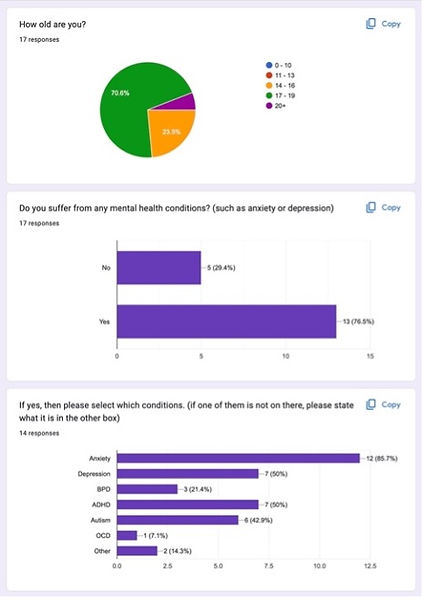


After this question if participants put no, then the questionnaire would end but if they put yes then another set of questions about dissociation would be available.
These were the next set of questions specifically about dissociation

Pre-Production
A key element of pre-production is story boarding. Since the music video has a lot of quick shots and I don’t know what order they will appear in, I am compiling a list of the shots I want to achieve. With explanation of how I will use them to represent disassociation:
Extreme close ups
-
The only extreme close ups I plan to have, is an eye. This adds emotions and makes the audience feel connected to the emotion that eyes hold. Eyes have often been linked to the soul. Therefore, it would create more empathy for the character and feelings that they are portraying.

This shot will be focused on the eyes. This is to show emotion or lack of emotion. This will also create a very. Personal connection with the audience.
Mid/Close ups
-
Having a milk bath. The idea of filming an actor underwater for a music video is no new concept. However, I want to play into that role of repetition as derealisation is a very tiringly repetitive cycle. The constant underwater scene in media is an idea that has been overplayed. So much that artists don’t do it anymore unless on a grand scale such as Harry Styles in his music video for “Falling” or Billie Eilish’s “Happier Than Ever” music video. I want to repolish that idea to give a sense of tiring re-occurring.
-
Another convention of a sad, dramatic music video is having makeup running either due to water or the actor smudging it. I like this effect as it clearly shows sorrow by the ruining of what was once perfect. The running makeup connotes that it is an outside source that a person has no control over is the reason they are not ‘perfect’ anymore.
-
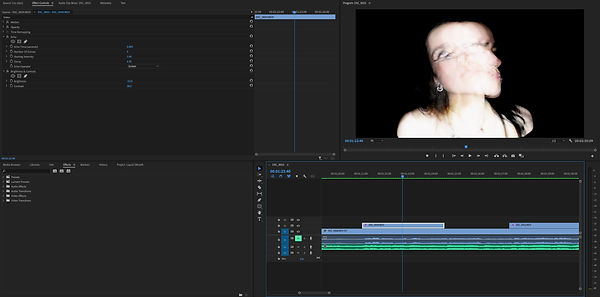
One effect that I have seen is a motion blur face effect which is difficult to explain so I found a tutorial video on how to do it which shows how it is supposed to look (https://youtu.be/XCrCY8n93oY?t=76). This effect will be on the characters face looking around the room then suddenly stopping and going back to normal looking directly into the camera. Having this effect amplifies the

Close up
This shot will be used to show emotion and to get more detailed shots but not close enough to make the audience confused.

Mid-Close up
This shot allows the audience to feel connected to the character and personally relate to them. It also allows me (as director) to show how disorientated someone can be with disassociation can be as quick cuts from close up to long shot to mid close up will create a sense of anxiety within the audience.
loneliness of depression and the memory loss/time skip of depersonalisation.
-
The shot I’m most exited for is the skin peeling effect. The skin peeling effect is where an actor places a layer of liquid latex on their face and peals it away as if it is their own skin. A famous example if this is Melanie Martinez in “Mad Hatter” (https://youtu.be/04UjShXZbD0?t=100). This shot was meant to instal confusion into the audience and frighten them. The shot also connotes the feeling of depersonalisation as self-harm is a method people use to feel more grounded.
-
Another conventional type of shot that I will be doing is the subject in the middle of the shot with a light spinning around them or them spinning into the light. This shot is used a lot in artistic music videos as it shows harshness and surrealism as it shows the actor has all sides apart from the front facing side we see as an audience.
Long shots
-
Falling into Water is a very cinematic way of showing someone’s downfall and I will use this to my advantage. Obviously, I don’t have a big pool of water so I will use green screen to give the effect of falling by having my actor standing facing to the floor hunched over. I will be able to manipulate this by adding a water effect over the top and spinning the image, so it looks like she is falling instead of a hunched over person.
-
On the beat drop I’m going to include a stock footage clip of a glass shattering in slow motion. With this quickly changing between the running makeup shot it will give a dramatic tense feeling within the audience.

As I said, a quick flash between a mid-close up, close up and long shot will create a disturbed sense of reality within the viewer. This shot also allows the audience to see the whole body and feel more connected with the character.
Mood Board

Filming Schedule
Day 1
Day 2
Day 3
Day 4
-
Skin Peeling
-
Makeup self-smudge
-
Falling into water
-
Close up of eye (without makeup)
-
Makeup ruining/ruined
-
Close up of eye (with bad makeup)
-
Motion blurred face
-
Honey
-
Light spinning Part 1
-
Makeup running water
-
Rain
-
Light spin Part 2
-
Baths (Light & Dark)
-
Pickup shots
Pre Production Vlogs
Stock Footage I Used
This effect was helped by this tutorial
Final Evaluation


The music video starts with a constant flash between flowers being frozen and flowers blossoming. This connotes what disassociation feels like. The constant flicker between being happier than ever and feeling stuck. This is a constant repetition for people who dissociate and I tried to replicate it visually.


As demonstrated the only colours shown in the actual lip-sync part of the video only has one colour which is the actor’s skin. This connotes the isolation of what dissociation can be. Many people who dissociate distance themselves from people because they feel so alone. Having the black infinity background connotes that they are alone in the endless void of what their mind can be.
A lot of filler footage is flowers being smothered in smoke. This is to connote the beauty in being drowned. What I mean by this is that it is a defence mechanism that our brains use to cover up a bad experience. It is known as a bad thing but our brains are trying to help so the brain thinks it’s doing good but in reality it is not.


In my music video a lot of the shots are with ruined makeup or in the rain. This is to show the “ruining of perfection”. The reason that I put perfection in “” is because perfection is subjective, but some may think that holding an image is perfect. However, others may think that just holding it together is perfect as it’s too hard to create a perfect image constantly. So ruining this perfection is something you have to do to help dissociation get better, as it is part of dissociative therapy.
This one is quite simple in the fact that it is a visual representation of what dissociation feels like. The constant blur of time, space and people is a common symptom of dissociation. This can be seen in person due to depersonalisation as well.


These shots reference the most negative effect of dissociation. Self-harm in hopes that the pain will make the depersonalisation stop. Depersonalisation is another common symptom of disassociating however instead of time or people around the person being affected it’s the person who dissociates (like discussed in research). The effect of skin peeling is to show the severity that some people go to, to not be dissociated and to show what it can feel like when you’re stuck in a dissociative state. The red face paint is meant to show the after effect. The reason the red comes before the skin peel is to show the time distortion for people who dissociate.


The quick flashing between the inevitable glass breaking and the eye shows sadness with someone who knows what is about to happen. this connotes that people who dissociate can feel when it’s going to happen which is what dissociative therapy helps to identify.
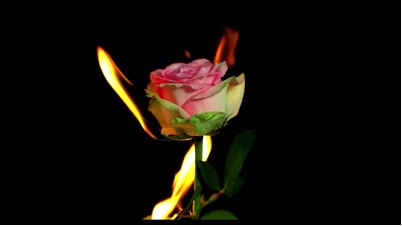
The burning flower is used to show the beauty in something destructive. This is effective to the audience to show how dissociation feels and to show the feeling how it can be saviour for some and a burden for others.
I included this shot to show to the audience how dissociation feels visually. This is also added to help people who don’t dissociate understand the perspective of someone who does. This is important to show as visual disturbances are a key aspect of dissociation and depersonalisation.


The ending of the video is meant to be sombre and incomplete. This shows that it is an ongoing struggle and will never be cured. This shows the audience that since the video ends with this shot and then a black screen you can loop the video and show the whole process again to represent the disorder.